Sunday, October 12, 2014

Home Page


White Four 20th Century Country Study

Collaborative effort:


Forest, Brooke, Ms. K, 
Sevin, Hannah, Lia,
Alex and Jack


The basics of this study is to enlighten the minds of others to the early imperialist societal standings of known countries today back in the early 1900's. Putting together historical narratives and accumulating helpful pictures and videos, our class hopes to open a door to new understandings of our worlds past history.  

Wednesday, October 8, 2014

Panama & Columbia


Columbia & Panama
 Panama

Panama is the south most country in Central America. Panama is populated by about 3.9 million people. The language spoken by the majority is Spanish and the national anthem is Himno Istmeno. 

           The Canal                                                        How?

The canal plays a major role                From 1903- 1914 the Canal was under 
in Panama. The canal connects           construction by the French, it cost America
the Atlantic and Pacific ocean,           about $375 million. They payed Panama
it is a cut through or shortcut that       $10 million and the French company was
can cut days off trips. Instead of        payed $40 million for the job. 
traveling all the way around South       
America, boats can pay to be able      
to go from the Atlantic Ocean
through Panama to the Pacific
Ocean. Today, the canal makes
on average $4.5 billion in tolls
per year. 

Columbia
Columbia is the north most country in South America. Columbia is populated by about 47.3 million people. The language spoken by most people is Spanish and the national anthem is Oh, Gloria Inmarcesible.

Hawaii

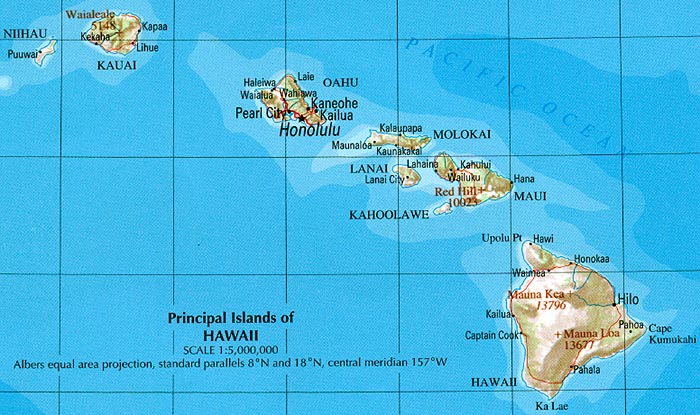
                                                                    Map of Hawaii
      Background: American planters entered Hawaii and King Kalakava gave them more and more political recognition; like equal trade agreements and a naval base. After the king died on January 29, 1891 and his sister, Liliuokalani took over rule as queen. Queen Liliuokalani was really hostile towards America because she was a Hawaiian nationalist.
Hawaii is 2,467 miles away from California, the planters had to sail that far. American's had to leave America to take control of Hawaii.
 
     In 1887 there was an equal trade agreement that allowed sugar to enter the United States free of taxes. King Kalakaua granted the US access to a naval base (Pearl Harbor) in 1887. King Kalakaua died January, 29, 1891. Hawaiian goods were now considered imports in the United States and therefore were subject to a tariff (tax on foreign imports). If Hawaii was part of America then there would be no tariff tax and American planters would make more money.Queen Liliuokalina was a nationalist and did not want American planters in Hawaii. Queen Liliuokalina believed that Hawaii was for Hawaiians. Queen Liliuokalina was set up and Stanford Dole took over as governor and that became direct rule. On August 21, 1959 Hawaii became America's 50th state. When the queen was in rule that was direct rule. 
                                                             
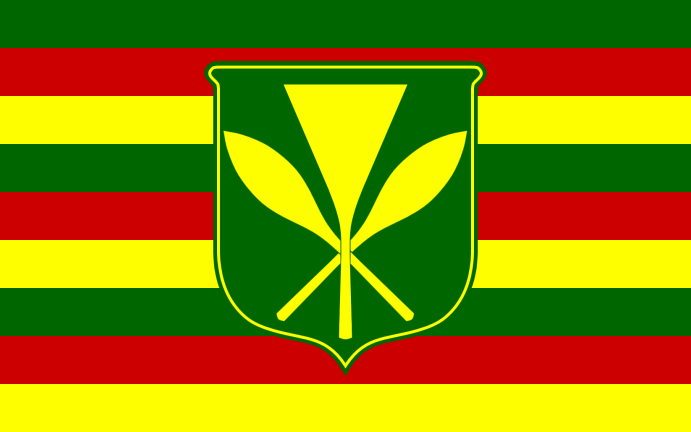
                                                                 the native Hawaii flag

                                                                      Facts to remember

  1. King Kalakaua gave more political recognition
  2. Queen Liliuokalani was a nationalist
  3. The United States set up Queen Liliuokalani and took control of Hawaii 
  4. Sanford Dole became governor of Hawaii


                                                             the state of Hawaii's current flag


                                                   Bibliography
http://kosmixmedia.com/static/94b6644b758194f654d16ed9b0546495.jpg

http://www.lib.utexas.edu/maps/us_2001/hawaii_ref_2001.jpg

http://www.loeser.us/flags/images/spanish/hawaiian_native_kings.gif

Mrs. Beuhner, 20th century class notes, C204

http://upload.wikimedia.org/wikipedia/commons/thumb/e/ef/Flag_of_Hawaii.svg/2000px-Flag_of_Hawaii.svg.png

Nigeria


Nigeria

Nigeria is located in West Africa and has many ancient kingdoms and empires that are continuing from the historic British colonization. The British was interested in Nigeria because the many resources Nigeria produces. Reguardless of the resources, Nigeria produced a slave trade by superiority from the British in 1472. The British would sail to Nigeria and collect slaves and then make a long voyague to the knew land. The British for trade would give the Nigerian Empire guns, and beneficial products for everyday living. In 1862, the British colonized the Nigerian Empire. As a result from the colonization in 1884, the Berlin conference was put into place to give Britain the official right to establish a colony. In 1905, a revolution over slavery began. The revolution was a fight for Nigeria's independence, but with a result of 2,000 natives were killed. British Governor Lugard was appointed to rule the territory and have direct-rule. During this time there was a continuous trial and error of the merging between North Nigeria and South Nigeria. Northern Nigeria was largely Muslim and ruled by Islamic leader called the Sokoto caliphate and he did not like the western culture. Northern Nigeria had a beneficial rule because of the amount of wealth it had and this provided a lot of revenue. Southern Nigeria was largely Christian and was influenced by Western and traditional African customs; Southern Nigeria also had a poor economy which resulted in a low revenue. In 1914 Britain merged the two together and Governor Lugard still held control of the area. The British ruled for 76 years over Nigeria; Nigeria gained independence on October 1, 1960. Nigeria's new constitution established a federal system with an elected prime minister and a ceremonial head of state.  

Nigerian Flag

The Nigerian flag is very important to the people of Nigeria. The two unique sea-green bands represent the forests and abundant natural wealth of Nigeria while the white band represents peace. The flag was designed in 1959 and was first officially hoisted on October 1, 1960. Nigeria still remains as a democracy, but if still influenced by imperialism. An outbreak of Ebola in West Africa, overwhelms health systems and has rapid movement to go across boarders. President Obama addresses a renewal of international systems. America is deploying doctors and scientists to help contain the outbreak of Ebola and to pursue new treatments. Other current factors of imperialism have been used in Nigeria because of the tragic kidnapping of hundreds of school girls in April 2014. President Obama informed the House Speaker that he would be sending around 80 forces to help search for the missing girls. These forces will come together and both forces will use their strength to fulfill their mission. Imperialism in 21st Century extends rapidly because of the intense and large nations wanting to continue to gain and use superiority to increase potential rulings that could benefit their country. 

To read more about these two articles, click on these two links:

Bibliography: 


Tuesday, October 7, 2014

Ethiopia & Somalia

Link 


ETHIOPIA & SOMALIA

Map Of Ethiopia & Somalia


                                                                                  Ethiopian Flag
ETHIOPIA:

The country of Ethiopia is located on the east sub region of Africa, or one of the few countries that border the horn of Africa. Surprisingly, Ethiopia is ranked the 13th greatest country in the world, and the population of Ethiopia compared to the world, is 1.33%.  The population count as recent at the current year, 2014, was 96,506,031 and the capital of Ethiopia is Addis Ababa. Lastly, the language the people speak in Ethiopia is Amharic. The flag of Ethiopia has changed to different versions, and the most recent flag, with the disc, star and rays was only changed on February 6, 1996. To this day, the Ethiopian flag is one of the newest flags in the nation. This is ironic because Ethiopia itself is the oldest independent African state. One interesting fact about the flag is that the colors that are represented on the flag are now known as Pan African colors, and today, sometimes black is added to represent the African people. 


Interesting Facts...
v Consists of 3 equal horizontal stripes; all with different meanings
v Red: power, faith, and blood
v Yellow: Church, peace, natural wealth, and love
v Green: Land and hope
v Colors also connect to the Holy Trinity and 3 main provinces of Ethiopia
v The star on the flag represents unity of the people and the races that make up Ethiopia
v The rays on the star represent prosperity 
v The blue background of the star and rays represents peace


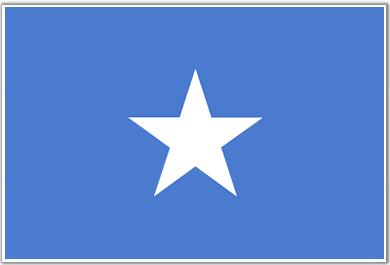
                            Somalian Flag

SOMALIA:


Somalia is also located in Africa, and is the country that makes up the horn of Africa. The current population of the country today is 10,805,651 people, and they rank 82nd in the nation in size and population from greatest to largest. The country Somalia takes up about 0.15% of the world population, even though the country itself really isn’t that small. The capital of Somalia is Mogadishu, and two of the languages they speak there are Arabic and Somalian. The country looks bigger than it actually is, and most people believe that it is because the country of Ethiopia intrudes where the center would be if it wasn't there. 


Interesting Facts...
 v The blue background of the flag originates from the flag of the United Nations and represents the blue sky that overlooks Somalia and the United Nations
v The blue sky that the background refers to is the motivation the country had to gain their independence
v the white star represents African freedom
v The five points ion the star represent the five historical regions inhabited by the Somali people; Italian Somaliland (Somalia), British Somaliland (Somalia), French Somaliland (Djibouti), and the Ogaden region of Ethiopia and North Kenya
v Between January 1991 - August 2000 the country had no working government
v A parliament government was formed in 2000 but it expired in 2003 without control of the country
v Just in 2004 a transitional parliament was instituted and that is the government that hold to this day


Glossary:
1. Holy Trinity: a Cathedral known in Amharic as Kidist Selassie; the highest ranking Orthodox Cathedral in Addis Ababa, Ethiopia

Link created by: Lia Burchard
Works Cited:

Pictures:

Monday, October 6, 2014

China

China is located in Asia. It has the highest population in the world with 1.3 billion people. It is known in history for being very conservative and independent. It was a world power for many years until the latter half of the Qing dynasty around 1890. They lost two wars known as the First and Second Opium wars. The leader of China at this time was named Cixi but she was also known as the Dowager.


During her reign, the martial artists of China rebelled against foreign influence. This was known as the Boxer Rebellion. 
There was widespread chaos as boxers were beheading any Christians, native and converted in the streets. The ambassadors from foreign embassies were terrified. Cixi was a quiet supporter of the Boxers, being very conservative herself. The Boxers fought the foreign embassies outside the forbidden city for two months. On August 20, 1900, a multinational army made up of English, French, American, German, Australia, Italian, Russian and Japanese troops ascended onto the Boxers and wiped them out. On September 7 1901, a treaty was signed ending the Revolution officially and holding the Chinese accountable for $335 million dollars of damage. The USA was overpaid with 24 million dollars. The USA put the extra money into a scholarship for Chinese students to get scholarships to attend American schools. 

With the reparations paid out China became incredibly weak. Cixi had lost all credibility and power and a revolution was brewing. 

By Forest Elliott

                                                                  Work Cited
     
     Mrs. Buehner, class notes on imperialism, 2014.